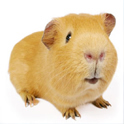
 Guinea pigs are among the cutest pets that people own. They are members of the rodent family and originate in South America. They are also known by the name “cavy” which derives from the scientific name Cavia aperea. Guinea pigs are born fully haired, eyes open and ready to run. They make great pets for adults and children alike and enjoy the human-animal bond that develops between owners and their pets.
Housing
Guinea pigs are very active pets so buy the largest cage possible. There are cages that are specifically made for guinea pigs that do not have wire on the cage bottom. This is an important feature as guinea pigs can get their feet caught in the wire and break a leg very easily or develop pressure sores on the weight baring surfaces of their feet.
Guinea pigs enjoy playtime and run and jump with obvious joy. They like tossing toilet paper rolls and even some small dog toys around. Providing tubes to run through and little houses to hide in help keep your pet content
Feeding
Guinea pigs prefer using a water bottle rather than a bowl if given the choice. Water bowls also tend to get full of litter and debris quickly so keep this in mind when purchasing your equipment.
Hay should be fed in abundance each day. Timothy, oat, sweet grass, and meadow grass are all very good and depending on the time of year, some if not all will be available. One important side note to remember: alfalfa is the “candy bar” of hays. Too much alfalfa can contribute to gastro-intestinal and urinary tract problems because of high protein content, so feed this type of hay sparingly. Offer dark leafy green vegetables daily as well at one-half to one cup per guinea pig. This will provide higher levels of vitamin A and increases fluid intake (as well as making life more enjoyable for your ‘pig. Stay away from carrots and other high sugar foods such as grapes, raisins, bananas, etc.
Guinea pigs have a unique dietary need. Because they can’t synthesize vitamin C, their diet must be supplemented with this vitamin. If they do not get enough vitamin C, they can develop scurvy. Depending on pellets or vegetables to supply is risky. Our hospital diagnoses over 50 cases of scurvy a year, most of these cases end with the death or euthanasia of the guinea pig. We recommend using human a vitamin C product and stock and sell it at the hospital. Pelleted foods can also be offered as a treat. one tablespoon given daily should be adequate.
Diseases
The most common problems we are presented with include: scurvy (hypo-vitaminosis C), urinary tract infections and stones, fungal and parasitic skin infections, and teeth problems. We will cover these problems in separate postings.
One thing to add about water bottle “cleanliness” –
You can clean your guinea pig’s water bottle with a 50/50 mixture of white vinegar and water. Just let it sit for a few minutes and rinse thoroughly. This will help eliminate any unwanted bacteria or fungus growth that may start to form on the bottle itself.
Good suggestion.
I really like the old fashion glass “milk bottle” water bottles. They are easy to clean with a bottle brush (have a large opening made for a rubber stopper) and do well in a dish washer. Sadly, they are difficult to find.
Alternatively, I like the Lixit bottles that the entire bottom (top) of the bottle opens for easy cleaning.
Hi I got a guinea pig yesterday its a girl and 3 months old. Do you have any name ideas?
I like Priscilla!
What ever you pick, it should pass my mother’s name test.
Once you’ve decided on a name you should go outside your house, stand in the street and yell the name as loud as you can for a full 20 minutes. If you don’t feel comfortable doing that you need to pick another name.
Cheers! Dr. J
I’ve owned about eight guinea pigs over the past twenty years, and I’ve always taken them to Avian and Exotic Animal Hospital. After seeing a sick piggy I’d purchased at a pet store, you recommended I consider Wee Companions next time, and adopt a healthy rescue guinea pig.
I did this, in 2002. I visited an adoption event at a PetSmart in Encinitas (as I recall.) I went there to get a new pet rat, because one of my two rat brothers finally hit his 1,000 day mark and died. His brother seemed lonely, so I wanted to get him a buddy. The Wee Companions lady, Fionella, as I recall her name, showed me a bonded pair of rats, two neutered brothers, and I purchased them. I also fell in love with little Kailey, a very skittish young guinea pig. Off we went.
The rats were just lovely pets, enormously fun and interactive. They lived out a normal lifespan. Kailey joined my two other piggies in our large plexiglass enclosure. She stayed in hiding often, but after regular attention and holding, she began to come out and play more.
You had told me to use Carefresh, not wood chips. You had told me to lace her fresh water with liquid Vitamin C, and feed her only fresh timothy hay, not alfalfa, much as this article mentions. I listened.
Now it’s 2012, and I’m happy to say that Kailey is with us still. Her cagemates are long gone, most lasting 7 years. Kailey is about 10 now. Her voice is a little quieter, but she still squeals for kale from the garden. I’m not sure she hears too well, but she doesn’t need to. If I let her run around on the floor outside her cage, I have to trick her to catch her — I cannot outrun her. She’s very happy. She coos loudly and continuously when I hold her.
I credit your sound advice, and my following it, for our having Kailey at all, and for the many years of pleasure we’ve had with her.
Wow! What a story! Thank you for your kind words, but it is your good care, some good genes (ad a little good luck) that has been most important to her longevity!
We see so many piggies with scurvy (vitamin-C deficiency), most of them die! I can’t emphisize to other guinea pig owners how important it is to supplement the diet with vitamin-C.
I have been feeding my guinea pigs iceberg lettuce once in a while. They have never acted weird after eating it. Someone told me it is poison to guinea pigs. I have had guinea pigs that have lasted 5 to 7 years and fed them iceberg lettuce. Is it true that iceberg lettuce is poisonous?
Nothing really wrong or bad about iceberg lettuce, it simply has NO nutritional value.
I guess if they ate a lot of it they could starve, but that is not likely to happen. It would be much better to feed them a more nutritious fresh vegetable portion of their diet. We recommend what we describe as “dark leafy greens.” Vegetables that are leafy, green and don’t have “lettuce” in their name. Dark leafy greens include dandelion greens, kale, collards, mustard greens, turnip greens, beat tops, carrot tops, parsley, cilantro, etc.
Great site. Plenty of helpful info here. I am sending it to several pals and also sharing. Thank you to your effort!
Can I feed my guinea pigs beets? They like the beet tops/greens, but I can’t find any food list that includes the actual beets. Also, is it true that potatoes are poisonous for piggies?
Beats, like carrots are high in simple sugars. A small amount would be OK, too much may cause diarrhea and other GI tract problems.
I gave my 9 year old daughter a guinea pig for her birthday. She has been wonderfully responsible for the guinea pig for 4 months. His cage never stinks! Recently the guinea pig developed some respitory problems. We took him to a vet right away and she put him on an antibiotic. He seems much improved.
My question is about his bedding. We have been using 98% dust free kiln dried pine from the feed store. The vet said this could be the problem and suggested recycled newspapers or Carefresh. These options are much more expensive than the pine. I have been researching the use of a fleece liner with puppy training pads underneath to absorb moisture. When I consulted the vet she said he might eat it. Couldn’t he eat any bedding option? What is your opinion on guinea pig bedding? Thank you so much for your thoughts.
You are correct. We see many GP’s kept on fleece or Chucks (under-pads) or the washable variety.
I agree that the paper bedding, Carefresh, etc., are the best for most people (because most will not care for the bedding as often as the under-pads, fleece, etc. need to be change.
The pine bedding is a respiratory irritant and may increase the risk of upper respiratory tract problems and pneumonia.
I have 2 Guinea Pigs, both male. One of my males is dragging its back feet and has rapid eye twitching. He is 1 year old. Can you help?
Mandi
Your Guinea pig’s signs are suggestive of disease of his brain and or spinal cord. There are many possible causes from trauma to infectious or metabolic problems. You need to find a veterinarian to take a look at him. We can get a pretty good idea what is going on from a physical exam alone, but tests may be necessary to make a diagnosis.
Meanwhile, keep him separated from your other pig and make sure he can get to food and water.
Best of luck! Dr. J
Dr. Jenkins,
One of our two sweet little piggies has had a stroke. We have no idea how old they are as they are each rescue pigs. It has been 4 days since the stroke. The first two days she did take water when I put the bottle in her mouth and she also ate twice from the feeder when I put it in her mouth (pureed timothy hay, water and carrot.) But yesterday and today she has refused both food and water though her neck had regained some muscle strength. She just lays on her towel but will move some occasionally. I realize she is in the dying process but I just don’t want her to suffer. Is there anything else I could be doing?
Hi Dr. Jenkins,
I have owned my GP for two years now and he’s starting to bite anyone that holds him even myself. I love him to pieces but I won’t own an animal that can hurt me or my grandchildren. They are not allowed to go near him without me being present and that is from day one. He came to me because my daughter bought him from a pet store and made so much noise she couldn’t sleep. He’s been a great emotional support pet for me and I’d hate to have to rehome him again.
Tanya. There are many reason that a guinea pig might become aggressive: lack of handling, hunger, pain (arthritis, back pain, etc.), and high hormone levels (testosterone) are the most common. I’d recommend that you start with a good physical exam by an exotic animal veterinarian and see if they cant whittle that list down a bit. Good luck!
My guinea pig has this weird looking red worm thing coming out of its butt and it “pops out” about twice a day. I do not know what it is and I am looking for help. He is a male and is about 9 months old. He also has these moments where he runs outside of his cage and hides under furniture and becomes highly aggressive, but after coming out of hiding he is back to normal. I am not sure as to why it happens but I think t has something to do with the thing coming out of his butt I have not found anything like this on the internet.
Hmmm . . . Not certain what you are seeing. Guinea pigs can have worms, but they are typicall very small. Snap a picture and take it with you when you see your veterinarian. I’m certain that there is a logical answer.
I am new to owning guinea pigs and believe one of my girls is sick. I took her to a regular vet and they were not helpful. Didn’t seem to really know what’s going on. She is on the smaller size at 13oz I’m not sure how old she is. She is not her normal social self I have not herd her make any of the normal guinea sounds either for a few days. She did however sound like she sneezed or coughed even She will eat some but then right back in her cave. She had some labored breathing the day before. Should I be concerned and bring her in right away?
Respiratory is always worrisome in guinea pigs. The good news is that new antibiotics available over the last 10-15 years have greatly improved our treatment success.
Often, guinea pigs with respiratory disease have discharge from their nostrils, on their face or on their “cuffs” where they wipe their nose. Other causes of respiratory signs (weakness, respiratory sounds, loss of voice, discharge, etc.) may be heart disease or neoplasia.
Call the hospital (if you are close) and we will get you in ASAP!
Hi!
My fiance and I have adopted two guniea pigs in February. We do not really know where they came from or their background, but apparently when we got them they were in perfect health. Recently as I was brushing one of our pigs I noticed some mucus around it’s eye. It was not a lot, but she had some green mucus clumped in her hair around her eye. Her skin looks a little more pink than usual around the eye area. Is this something we should be highly concerned about? Or will it go away over time?
Thanks.
If you piglet has an eye infection, typically the eye itself would be red and irritated. Guinea pigs do have a lot of salts and mucous in their tear (more than we do) and if the tear runs down their face it will leave a sticky to crusty white discharge in the hair around the eye. Most of the time that is due to environmental causes (dust from bedding or hay). Occasionally it is caused by a blocked tear duct.
If the discharge continues, we should take a look.
Hi would like to schedule an appointment for my guinea pig ? she is four month old and had her partner passed want to make sure everything is okay thank you
Hi! Sorry for the slow reply. We are not very active here and I hope you have had the opportunity to get you bunny checked out. If not, call the hospital at 619-260-1412 and we’ll get you cared for. My condolences for her partner.