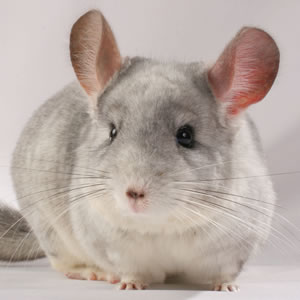
 Chinchillas make wildly amusing, playful, as well as loveable pets. A chinchilla with good diet and husbandry can remain in your family anywhere for over 20 years with average life spans over 10 years. The average male chinchilla weighs between 400-500 grams, while the females can reach 600 grams. Chinchillas love to play and require lots of attention from their owners. Supervised playtime is the best way for you and your chinchilla to interact and bond. Since they love to chew and are extremely curious, check that electrical cords, toxic plants, or anything breakable is out of reach of your chinchilla.
Grooming/Bathing
The Chinchilla is unique in their its grooming habits. Unlike most mammals, the chinchilla does not bathe in water. Instead, they take dust baths. A wet bath mats hair and strip natural oils which protect their skin and help regulate body temperature. The dust bath is done in volcanic dust, common in thier native homes in the Andes. This dust that can be purchased at your local pet shop, or from most chinchilla breeders.
For approximately ten minutes, every day or every other day, place a deep bowl containing a small amount of the dust in your pet’s cage. Sit back and watch as your chinchilla rolls, flips, and plays in the dust! It is always best to remove the dusting container immediately after a bath to prevent the dust from being soiled with feces, food, or bedding.
Feeding
The basic chinchilla diet consists of a small amount of chinchilla pellets, along with a good quality grass hay. If chinchilla pellets are difficult to find, they can be substituted with rabbit or guinea pig pellets. Be sure the food stays fresh and clean. Chinchillas can be offered treats of fresheafy green vegetables kept to a minimum. Most chinchillas love a raisin or an apple slice as a treat! Water should be offered in a bottle placed on the outside of the cage. The water should be changed, and the bottle thoroughly cleaned at least every other day to prevent harmful bacteria growth.
Housing
Since chinchillas love to jump, run and play, wire cages are most suitable for pet chinchillas. An adequate size cage for a single chinchilla is 3 feet by 2 feet. Of course, the bigger the cage, the more room they have to run and play, resulting in a happier pet, along with more entertainment for you! The bedding of the cage should be carefully considered. Try to avoid wood shavings that can irritate their delicate noses or complicate their breathing. Our hospital recommends a product called Carefresh, a paper based bedding that is soft and absorbent, however, something as plain as newspaper works well too. Location of the cage is a vital decision. Be sure to avoid any drafts, damp rooms, direct sunlight, or heat sources.
Common Problems
Teeth
Overgrown teeth is a common problem among chinchillas. The spurs or points of the teeth can do serious damage to your chinchilla if it goes untreated. Watch for any changes in your chinchillas eating habits, excessive drooling, or even diarrhea. Having your vet perform an oral exam on your chinchilla can help prevent the teeth from overgrowing. If you observe any of these signs you should see your veterinarian immediately.
Heat stroke
Chinchillas are intolerant of hot temperatures over 80*F. During hot and humid weather, use room or ceiling fans to cool the room, place bottles of frozen water in the cage, or turn on the air conditioner if you have one. Avoid direct sunlight and car trips in the heat.
Gastrointestinal
Become familiar with a normal stool for your chinchilla. Being able to recognize changes in your pets feces can help you catch problems before it becomes to advanced. If your chinchilla has diarrhea, feed hay only (hold back on the treats) until stool is formed. Offer lots of water to replace lost fluids. If the diarrhea continues, or your chinchilla stops eating or drinking, a trip to the vet is a must. Small fecal pellets are a sign that your pets food intake is reduced. This may signal dental problems.
Artcle by By Christine Hancock
Supply the chinchilla with fresh food and water daily. Oats, fresh fruits and vegetables such as apples, bananas, pears and carrots are a good diet for chinchilla. Raisins are also good treats for chinchilla; however, limit raisins to only one or two a week.
Is this accurate about feeding my chinchilla fresh fruits?? I often treat my guinea pig with some added fruits from time to time and would like to know if I can offer these fruits to the chinchilla??
Lora
Your advise is good with the warning that treats high in simple sugars (these would include bananas, carrots and grapes) are MUCH more likely to cause GI upsets and potentially life threatening diarrheas than treats with complex sugars (leafy green vegetables, apple slices, peppers, pieces of uncooked squash, etc.), or non-carbohydrate treats such as unsalted, shelled, sun flower seeds, slivered almonds, etc.
I am going to be getting two chinchillas, both girls(not like it has anything to do with my question), and I can’t find any chinchilla pellets. I was going to get rabbit pellets but then a lot of sources were saying that I should most definitely not get rabbit pellets because they are dangerous, or bad. What do I do, please help me.
Questioningly,
Mia Poyer
We took out Chinchilla to the vet because her eating habits have chaged…and so has her temperment. The vet said that she has spur growths on her back teeth and was going to perscribe a pain medication for her until I can pay for her dental proceedure but I thought I would see if there is anything else I can do to ease her pain for the time being. Can I give her teething/gum dissolvables meant for babies? Is there anything less expensive than a pain persrciption?
Thank you for your time and assistance,
Cassie Nafziger
Cassie
Sorry for the slow reply, I seem to have lost some of the posts from the web site. I hope your friend is doing well.
Having teeth problems are very irritating to your chinchilla and eventually will prevent her from from eating all together. See if your veterinarian has a credit plan (we offer Care Credit that allows you to pay off a bill in 90 days with no interest).
Hello!
I have an 8 month old chinchilla Sookie. About 6 days ago she ran into the sofa tearing her nose and requiring her to have 6 stitches to brnig it back to norma.. Shes doing fine, healing beautifully and back to her old demanding, loving self 🙂 I unforutnately live in Bermuda where there isnt much information or expertise on the chinchilla and I dont entirely trust their answer to this question. when will it be ok to allow her to bathe again? I know that shes not only unhappy about not geting playtime for a bit but I’m sure not bathing is upsetting her also, but I dont want to do anything that will cause her wound to become infected or irritate her.
Thank You In Advance!
Jessica Schuler (Sookie’s mommy)
Jessica
As soon as there is no bleeding or discharge from her wound she should be able to dust bathe again. Wash her dusting container well and use fresh dust and she should be fine.
Cheers, Dr. J
Good Morning,
I have a chinchilla that has skew back teeth, this has been filed down twice, and x-rays have been taken that show no real problem. But my chin keeps drooling! We have put off the aircon and have put fans in the room with her – and it seems to have reduced the drooling abit. But she is still wet now and then!
any advice please Dr? Thank you! Cupcake.
Nicole
If she is still drooling she still has oral pain.
Pain medication may make a difference (if the source of the pain is tooth impaction or root pain) but there is a good chance that thee is still a sharp point in there! If you feel that your veterinarian is competent and experienced with chinchillas then have him/her take another look. If you do not feel good about him/her, get a second opinion.
Thank you very much for the reply Dr. Dr. The first time the teeth were filed down by an exotic vet, for a month this went fine without drooling, then it started again, thus I took her back, and the same vet filed down again – however this time the drooling continued for 2 weeks. The same vet then referred me to the dental specialist, he then took the X-rays, and said that the roots are still ok, and he filed the teeth nice and short. It is now a week later, the drooling has reduced, but it is still there – she does eat, and the weight fluctuates very little between 5g or so this last week. Could she still be drooling due to getting used to the new bite? Or should there be no more drooling now anymore? I am very concerned! Should we have the vet do a CT scan, or maybe blood tests. Has Dr. Ever had this before? Thank you! Nicole
I was wondering if it would be possible to house a mother chinchilla with her two male kits permanently if they are fixed ? I heard that its not recommended cause they will fight when the female is in heat … But if she is altered will that still be an issue?
Our new chinchilla is tested positive for giardia. We have been using reverse osmosis water. Our current vet in Pasadena, CA prescribes the infected chin for 5 day of 0.15ml Panacur. Schedule to have a second stool test three weeks after treatment. However, at the 6th day, she still has soft/runny stool with mucus. What should I do? Should I continue the treatment? I also give her some acidophilus along with Panacur.
Well, there are a couple of problems here. If your fluffy friend really has Giardia, the Panacur (fenbendazole) is not going to fix it! (And the acidophilus is a waist as well . . . Not a normal bacteria for your chinchilla.)

There is also a possibility that what they thought was Giardia
is something else. Chinchilla have a flagylated organism that is “normal flora” that could be confused as Giardia and it is found more often if they have diarrhea (but Giardia can be a problem in Chinchilla). If it is Giardia, it has likely been present in the chinchilla since it was young / exposed to other chinchillas and the current problem likely was initiated by other / additional problems: diet, stress, etc.
I can’t make specific recommendations without seeing your pet, but in general, we would treat cases like yours with an antibiotic / sulfa drug and metronidazole, a drug that is effective in killing flagylates like Giardia.
Thank you, Dr. Jenkins!! Your reply is very informative and explains why the the chin still have soft stool after treatment. I spoke with the vet during the visit about metronidazole. The vet refused to prescribe mentroidzaole to the chin due to possible hepatic effect. I wish we are closer to your hospital. I can’t find any experienced exotic vet around Pasadena. Do you have any other vets to recommend? Once again, thank you for your time!! 🙂
Unfortunately, there is not another practice equivalent to ours in Southern California. I can tell you that we regularly have clients come from all over Southern California (and some from all over the US). Come on down!
Alternatively, I can do a phone referral with your veterinarian (if they are open to that).
Hope all goes well.
Cheers, Dr. J
Thank you for your note referral. Based on your referral, our local vet prescribes 0.25 ml of Metronidazole(50mg/ml) twice a day for 7 days. Our chin weighs about 730g. However, at the 3rd day of metronidazole treatment, the chin is very lethargic and not eating/pooping much. I am worried that the dosage is too strong for her. Is there an alternative dosage?
That is the dose we would start with as well. Let me know how she does. If she continues to go down hill I’d have you miss a dose or two rather than reduce the dose.
Best of luck, Dr. J
My chinchilla Gretel has scruffy spots on both hips due to the cross bars on her old wheel rubbing on her fur after she reached full size. There are no bald spots or injuries to her skin.
She’s had a new wide wheel without any bars for nearly 4 months, but the fur doesn’t seem to be regrowing. Her breeder thinks she’s pulling out her fur due to anxiety, but I’ve never seen her do this, and she seems pretty happy and playful to me.
Are their any supplements I can give her to encourage hair growth? How long should it take until she’s restored to her original fabulous furry self?
Could what you are seeing be mated hair / fur? That would be the most common problem we see in chinchillas who’s wheel rubs on their legs or sides. If so, the mats may need to be shaved off.
The answer to your wheel problem is to get a metal flying saucer. You can get them from Quality Cage Company. Her is a video of chinchilla running on one:
http://www.youtube.com/watch?v=0aTq1NPbEMM
I just adopted two healthy chinchillas. I discovered that the previous owner did not feed them a great diet of 18% or higher fiber. I switched them over to the Oxbow Young rabbit brand as it matched the Chinchilla formula almost identically. I followed their recommendation to switch foods. My chins are at 3/4 new food and 1/4 old food now. I noticed that the beige chinchilla’s droppings are now much larger than they used to be, and a bit more rounded. Consistency is the same, so they are odorless, compact, easily vaccumed (not squishy). Is this okay?? They seem so much larger than their droppings when they first came. Also, one of them had a fungus infection in the past. How worried can I be that this is going to come back? The owner told me to put a bit of fungus powder in their bath at least once a month, but I don’t know if I should follow this advice.
The fecal pellets are larger because of the added fiber in the diet, that is good.
The fungal infections are “baby mammal” problems. As your chin’s get older they are less and less likely to become infected again. Additionally, the most common fungal infections, ring worm (dermatophytes) infection are caused by Trichophyton sp., most often T. mentagrophytesm that are associated with high organic content substraight (read that, raised on dirt or filthy caging).
I have a Chinchilla that is just over 4 years old. In the past week he has been chewing up his small nut treats into tiny pieces, he still eats them but makes very small pieces first. His teeth seem to be normal, is this something I need to take him to the vet for? His droppings seem normal also.
As you note, most chinchillas that have problems with their teeth have small stool and most often give up eating hard foods (like their nuts).
Could be that your chin has just changed his behavior, however, I would have you watch him carefully for several days to be sure all is well.
I have s young chin who had hair around the base of his tail missing in a perfect ring. He also had hair loss around hind legs. One leg was missing all the hair from his knee down and the skin appeared flaky. The vet we took him to was concerned about fungus and we were given grisoflaven and told to bathe him twice weekly with hexachlor shampoo. I was afraid to bathe him because i was told that getting them wet could cause problems. What do you think?
Chinchillas molt (shed) their hair in a wave or line that starts at their nose and works its way to their tail. The hair falls out on the tail side of the line and grows back on the head side. My guess is that your chinchilla is having a heavy molt and you just happened to see it at the time it is reaching his tail and back legs.
My chinchilla developed diarrhea today last night he had wet stool and today he has been more vocal then normal I give my chinchillas treats daily cause I didn’t know do you think this has to do with the treats he is still eating and drinking but not playing or running around I am worried. his buddy is not having any of the same problems
Most diarrhea in chinchilla is diet related. If your chinchilla is acting like she is sick (hunched, sleepy, not eating and drinking, etc.) it needs to go to the veterinarian! Typically the best response is to cut back or stop feeding any treats, sweet fruits or vegetables (carrots, apple, banana, raisins, etc.) and cut back or stop feeding pellets. Push hay and a small portion of dark leafy greens (no lettuces).
Hi. Im fostering a chinchilla for a friend and in my town it’s hard to find chinchilla food. I got him guinea pig food and he seems to not be eating that or he eats a very small amount. Im not sure if there is a problem but I am worried that he isn’t eating. What can I do?
Maryjean
We recommend that chinchillas eat a combination of pellets and grass hay and a small amount of dark leafy green vegetables (parsley, cilantro, collards, kale, mustard greens, turnip tops, beat tops, etc. Not lettuces).
Chinchilla pellets are the same as rabbit pellets (just cut longer). Many chinchillas become overweight when eating pellets free choice so a measured volume must be fed.
You can always tell if your furry friend is eating by keeping track of the number and size of droppings in the cage.
Hope that helps!
The feeding information is a little over 2 years old. Things can change very rapidly in the world of medicine and nutrition. I have ‘inherited’ a chin who was neglected to the point of abuse and am cramming to learn everything I can from reliable sources. I want to make sure there have been no updates or changes in what constitutes a healthy diet for this poor little girl. Also I note the ‘no lettuces’ and wish to confirm that includes no leaf lettuces?
Thank you VERY much for the information posted here. Would you have recommendations for further reading? I am well versed in Ferret medicine, but this is unknown territory for me.
Sincerely,
Brenda and Katie Did
Brenda
For clarity, there is really nothing wrong with the lettuces, other than they don’t have much, if any, nutritional value.
Chinchillas, like rabbits, guinea pigs and other “cecotroph forming herbivores” get most of their nutrition from eating cecotroph. The diet you feed provides the building blocks for cecotroph and fill in some holes (vitamin A, etc.)
I was told that chinchillas cannot get wet at all. That if they do their fur can mold and kill them. Is this true and if so how would you be able to use frozen bottles of water in their cage?
Leslie
As you can well imagine, wild chinchillas get rained on and survive just fine. Also, we are called on fairly regularly to clean any of a number of substances off the coats of chinchillas that have made a miscalculation and ended up in the wrong place at the wrong time!
We don’t recommend that you wash your chinchilla however, many chinchilla owners use a frozen water bottle to keep their fury charges cool on hot days. The small amount of condensation from the bottle will not cause a problem with their fur.
Thank you Dr. Jenkins.
I noticed that my chinchilla leaves some dust and some crumbles in her pellet dish. I don’t know if this is recent or has always been so. I feed her Oxbow chinchilla pellets and Timothy hay. She also is given apple sticks, cholla wood, and bird kabobs, all of which she chews well. She’s six years old, a good weight, and energetic. Should I be worried about the condition of the pellets or could the pellets be the problem through such things as humidity?
Thank you,
Sammie
Dust and crumbles in a food bowl is most often related more to the diet than the chinchilla. As the pellets age they become drier and fall apart more easily. And yes, this is typically a sign it’s time to get new pellets (and, maybe, have a talk with your pet shop / pellet supplier!).
Chinchillas with teeth problems loose weight and, very soon, salivate.
Thank you very much!
Sammie
Are rabbit pellets okay for chinchillas?
How many pellets am I supposed to feed two young female chinchillas?
Freaked Out,
Mia Poyer
Mia
Sounds like you’ve been reading the forums!
The only difference between rabbit pellets and chinchilla pellets is the length that they are cut (which doesn’t make a difference for long!)
We recommend all chinchillas eat hay as the foundation of their diet and a high fiber pellet for adults.
If you are close, we sell hay as a fund raiser for a local rabbit rescue and we sell Purina High Fiber pellets.
Hope that helps.
Cheers, Dr. J
I have a chinchilla, full grown, female. She has been keeping one of her eyes closed all day as if something is wrong with it. I checked and there isn’t any discharge, redness, or debris. She lets me touch it so i don’t think it’s hurting. Could it be an eye infection or just a temporary irritation?
Most common eye problems in Chinchillas are injuries; scratches from hay, etc. Rinse her eye out well using saline solution and if it’s not way better right away you should have it seen. We don’t like waiting on eye problems!